

Passing a prop firm challenge can feel like the main objective, but it is only one milestone. Before purchasing an evaluation, traders should understand what happens after they pass: when the first payout becomes available, which conditions must be satisfied, how much profit can actually be withdrawn, and what could delay or prevent payment.
This matters because two challenges with similar prices and advertised profit splits can lead to very different first-payout experiences. One firm may allow a reward request after a defined waiting period, while another may require qualifying trading days, a minimum profit amount, or compliance with a consistency rule. Some programs also restrict the first withdrawal even when the account has generated a larger profit.
The smartest approach is to evaluate the payout process before paying the challenge fee—not after earning a profit. The following comparison examines five firms through the specific question that matters at the beginning: what must a trader check before expecting the first reward?
Start With the First-Payout Timeline, Not the Profit Split
The first payout has several separate milestones, and confusing them can create unrealistic expectations.
- Challenge completion: The trader meets the evaluation objectives.
- Funded-account activation: The firm issues or activates the next-stage account under its program.
- Payout eligibility: The waiting period and any trading, profit, consistency, or compliance requirements have been satisfied.
- Request approval: The firm reviews the account and confirms that the request meets its rules.
- Payment settlement: The approved reward moves through the selected payment channel.
These milestones do not necessarily happen on the same day. Passing a challenge does not automatically make profits withdrawable, and becoming eligible to request a payout does not guarantee that the money will arrive immediately.
A useful example is a program that allows the first request 14 days after the first trade on the funded account. That does not necessarily mean 14 days after purchasing the challenge, nor does it mean payment is guaranteed on day 14. The trader must still meet the applicable conditions and complete the request process.
Before choosing a challenge, identify the exact event that starts the payout clock. It may be the first funded trade, the activation date, or another event specified in the program terms.
Five Firms Viewed Through the First-Withdrawal Test
Instead of treating payout policies as a simple ranking of percentages, compare the conditions that stand between a successful trading period and an approved first reward.
1. FTMO — Check the Account Type and the Request Procedure
FTMO offers a clearly documented reward-claim process, but traders should first identify which account type they intend to use.
For an FTMO Account originating from the standard 2-Step Challenge, a reward claim can generally be submitted on or after the 14th day following the first trade on that specific account. Before making the request, all open positions and pending orders must be closed. FTMO reviews the claim and states that it typically notifies the trader within one to two business days. After approval and completion of the required withdrawal information, payment is typically sent within another one to two business days after invoice approval.
The reward share also depends on the program. The standard 2-Step route starts at 80%, with the possibility of increasing to 90% under applicable scaling or premium conditions. Accounts originating from the 1-Step Challenge have a different reward arrangement.
What should a buyer check before paying?
First, confirm the exact challenge and resulting account type. Second, understand that the first-payout date is tied to the first trade on the relevant account rather than the original challenge purchase. Third, make sure the available payment methods and their minimum amounts suit your circumstances.
FTMO is a useful reference point for traders who prefer a documented claim process. Its published guidance distinguishes eligibility, review, and payment rather than presenting them as one guaranteed event.
2. The5ers — Look for Minimum Profit and Verification Conditions
The5ers is worth examining if a trader wants a recurring withdrawal schedule and is comfortable working within defined eligibility requirements.
Its High Stakes program has a published biweekly payout structure, with the first withdrawal generally becoming available 14 days after the funded account is activated. Later requests follow the applicable two-week cycle. The firm also specifies minimum-profit and program-specific payout conditions, so the schedule alone does not tell the full story.
The important pre-purchase question is whether the account can meet the minimum needed to make a withdrawal worthwhile. A trader who earns a small profit may reach the end of the waiting period but still be unable to request a payout if the required threshold has not been reached.
Verification and account-compliance procedures deserve attention, too. Payment methods, transfer charges, and processing timelines may differ. The rules for one The5ers program should not automatically be assumed to apply to another.
Before buying, check the minimum eligible withdrawal amount, the definition of the first-payout date, and whether any additional verification step must be completed before the firm releases a reward.
3. FundedNext — Compare the Specific Reward Model
FundedNext illustrates why it is important to select the payout model before evaluating a challenge’s headline reward share.
Its published Stellar 2-Step options include different reward schedules. The standard option generally makes the first Performance Reward available after 21 days, with subsequent rewards on a 14-day cycle. Other options use shorter or on-demand request structures, but those come with their own eligibility requirements and reward-share arrangements.
For example, a shorter cycle may require a minimum number of profitable days and a specified profit result during the cycle. An on-demand model can require account growth and compliance with a consistency condition. These are not interchangeable terms: the model offering the shortest wait may not be the one that best fits a trader’s normal performance pattern.
A buyer should compare the exact option selected at checkout against the official rules. Do not assume that a firm’s fastest advertised payout option is included in every challenge or that it carries the same reward share as its standard model.
The key question is not merely “How quickly can I request a payout?” It is “What must my trading results look like for that request to be accepted?”
4. FundingPips — Confirm the Cycle and the Conditions Attached to It
FundingPips is another firm where the payout model selected matters. Its published reward arrangements and payment procedures should be checked together, because a withdrawal cycle and the mechanics of receiving the payment are two separate issues.
Before purchasing, confirm when the first reward request becomes available for the specific program, how the subsequent cycle works, and whether the chosen arrangement has additional eligibility conditions. Also review the steps required before a request: the firm has published instructions requiring traders to close positions and pending orders and to wait at least 15 minutes after closing the last trade before requesting a reward.
Payment routes can include options such as cryptocurrency, card-based payments, Rise, or bank transfer, depending on eligibility and availability. Different methods may involve different minimums, fees, and settlement times.
The practical lesson is to avoid choosing a challenge based on a short advertised payout interval alone. Make sure you understand both the conditions for requesting the reward and the requirements for completing the payment.
5. Leofins — Understand the Early Payout Caps Before You Buy
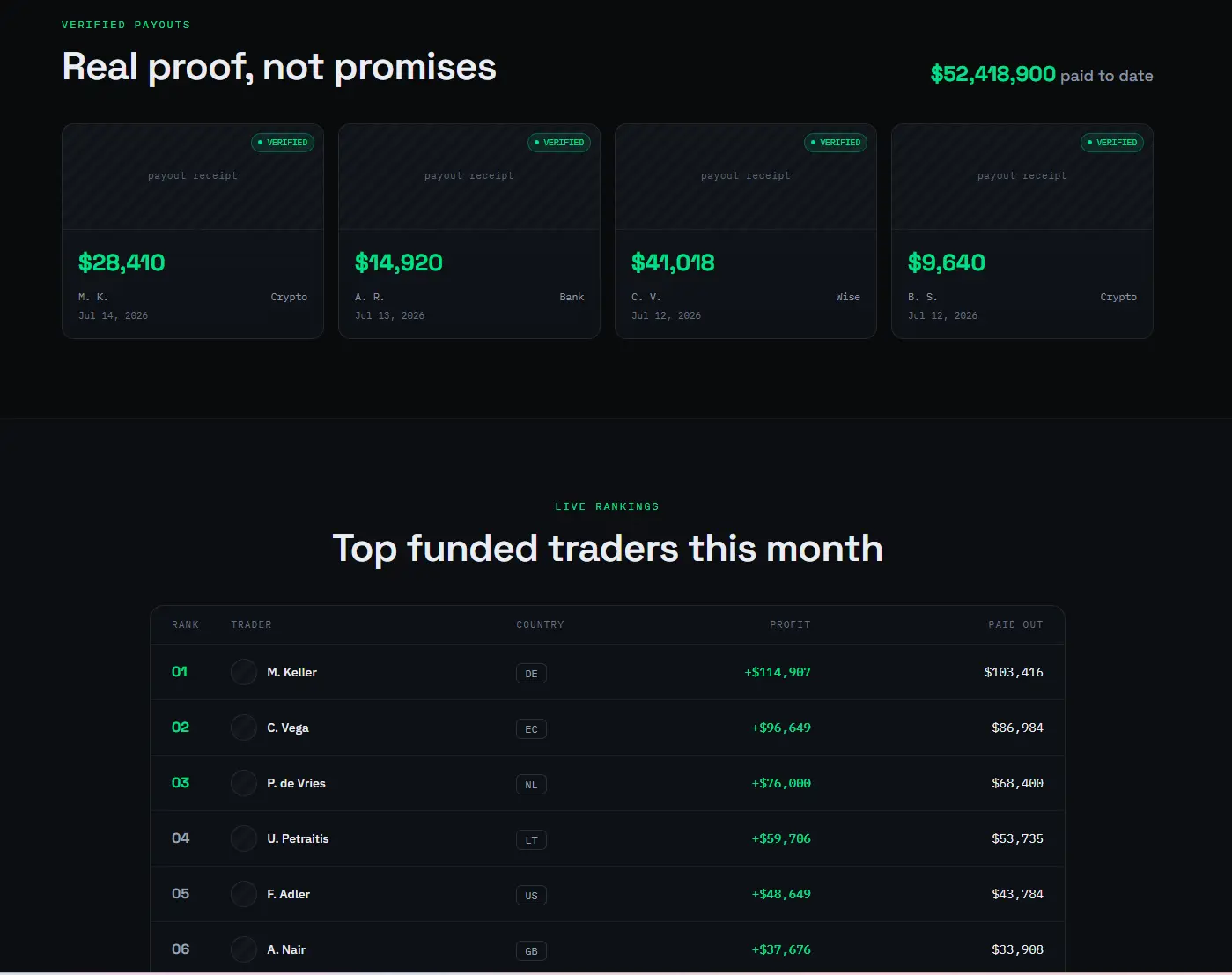 Leofins is particularly relevant to this comparison because its published policy sets out the first-payout timeline alongside explicit limits on early withdrawals.
The firm offers three CFD evaluation paths: Core 2-Step, Edge 1-Step, and Starter 3-Step. Under its published terms, Core and Edge make the first payout available after 10 days, while Starter begins at 14 days. After the first payout, all three programs move to weekly payout opportunities, subject to the applicable eligibility rules.
The initial reward share is 85%. It increases to 90% after three payouts and 95% after six. However, a trader should not assess this progression without also checking the first three payout caps:
- The first payout is capped at 3% of the account size, with a further $10,000 cap.
- The second payout is capped at 5% of the account size, also subject to a $10,000 cap.
- The third payout is capped at 7% of the account size, again subject to a $10,000 cap.
- From the fourth payout onward, the published policy removes these payout caps.
Leofins states that eligible profit exceeding an early payout cap is carried forward to a later payout rather than confiscated. This distinction is important: the amount displayed as profit in an account may be greater than the amount available for the first withdrawal.
Another condition to review is the 40% Best Day rule. A single trading day cannot account for more than 40% of the total profit in the relevant payout cycle. A trader may therefore be profitable overall yet need additional qualifying results before the payout request meets the rule.
The challenge-fee reward also depends on the program: Core and Starter include it with the first payout, while Edge provides it with the second, according to the firm’s published terms.
For a prospective buyer, the central question is whether the early caps and Best Day condition fit the way they expect to generate profits. The weekly schedule and increasing reward share may be attractive over time, but neither removes the requirements attached to the first withdrawal.
Current program details are available at www.leofins.com.
The Pre-Purchase Audit: Seven Checks That Can Prevent a Surprise
Before paying for any challenge, open the firm’s payout policy and answer the following questions in writing. If the information is unclear, ask support to clarify the specific program rather than relying on a general promotional page.
| Rank | Prop Firm | First Payout Timing | What to Check Before Buying |
|---|---|---|---|
| 1 | FTMO | Generally from day 14 after the first trade on the relevant FTMO Account from the 2-Step Challenge | Closed positions and pending orders, claim review, account-specific terms |
| 2 | The5ers | High Stakes: generally 14 days after funded account activation | Minimum profit, program-specific requirements, payment methods |
| 3 | FundedNext | Depends on the selected model; standard Stellar 2-Step generally allows the first request after 21 days | Profitable-day requirements, consistency conditions, reward share |
| 4 | FundingPips | Depends on the selected program and its payout rules | Waiting period, request requirements, closed trades, payment fees |
| 5 | Leofins | Core and Edge: 10 days; Starter: 14 days; weekly payouts thereafter, subject to eligibility | Early payout caps, 40% Best Day rule, reward share, challenge-fee reward conditions |
Payout schedules and conditions may change. Verify the current terms for the exact program before purchasing.
Calculate the First Payout, Not Just the Account Profit
A simple calculation can reveal whether a program’s conditions match your expectations.
Suppose a simulated $50,000 account produces $2,000 in eligible profit. At an 80% reward share, the trader’s calculated share would be $1,600 before any applicable transfer costs or other adjustments. But that amount is not necessarily the amount that can be withdrawn immediately: a payout cap, minimum threshold, consistency rule, or other condition may restrict the request.
For Leofins, for example, a $50,000 account’s first payout cap of 3% corresponds to $1,500, subject to the additional $10,000 cap and all eligibility rules. If the eligible profit is above that limit, the firm’s published policy says the excess is carried forward. This illustrates why traders should calculate the permitted withdrawal separately from the displayed profit and the nominal reward share.
When comparing firms, make three separate estimates:
- Eligible profit: The profit that qualifies under the firm’s rules.
- Permitted first withdrawal: The amount allowed after applying any cap, minimum, or other payout restriction.
- Expected amount received: The approved reward after the applicable split and any payment-related costs.
These figures answer different questions. Keeping them separate makes it easier to compare programs without confusing a large simulated account balance with money available for withdrawal.
Frequently Asked Questions
Can I receive my first payout immediately after passing a challenge?
Usually, passing the evaluation is not enough on its own. You may still need to complete account activation, satisfy the first-payout waiting period, finish identity verification, and meet all funded-account rules. The exact process depends on the firm and account type.
What is the difference between payout eligibility and payout processing?
Eligibility means the account meets the requirements for submitting a request. Processing begins after the request is submitted and may involve compliance review, approval, invoicing, and payment-provider handling. A published eligibility date is not a guaranteed date for receiving funds.
Are first-payout rules the same for every account size?
Not necessarily. The waiting period may be consistent across account sizes, while payout caps, minimum withdrawal amounts, or scaling conditions can depend on the selected program or account. Always read the rules for the precise challenge you plan to buy.
Can a firm change payout terms after I purchase a challenge?
Policies and product terms can change, and firms may apply different terms to accounts purchased at different times. Keep a copy of the rules and agreement applicable to your purchase, and check how the firm handles changes to existing accounts. If a condition is important to your decision, obtain written clarification before paying.
Is a prop firm’s funded account real trading capital?
Many retail prop firms operate evaluations and funded stages in simulated environments. Rewards may be paid as real money under the firm’s agreement, but the account balance should not automatically be interpreted as cash owned by the trader or as a conventional brokerage deposit. Read the firm’s disclosure and contractual terms.
Choose the Challenge With the Clearest Route to Your First Reward
The first payout should be part of the buying decision, not an issue to investigate after passing an evaluation. FTMO provides a defined claim process, The5ers uses a recurring schedule with eligibility conditions, FundedNext offers distinct reward models, FundingPips requires attention to both its payout cycle and payment procedures, and Leofins combines early payout caps with weekly opportunities and a reward share that increases over time.
None of these models is automatically best for every trader. The right choice depends on the account type, how consistently the trader can meet its requirements, the amount that can be withdrawn in the first cycle, and whether the payment process works in their country.
Before checking out, make sure you can explain—in your own words—when your first request becomes possible, what might prevent approval, and how much you could actually receive. If those answers remain unclear, pause the purchase until you have verified the terms.
Prices and conditions are current as of October 2026.
Risk disclaimer: Proprietary trading evaluations involve financial risk. Challenge fees may be lost if an evaluation is unsuccessful or program rules are breached. Simulated trading and funded-program results do not guarantee future performance or income. Review the current terms carefully and never spend money you cannot afford to lose.